






Statistics – accelerated secularization in more than 100 countries in 2025
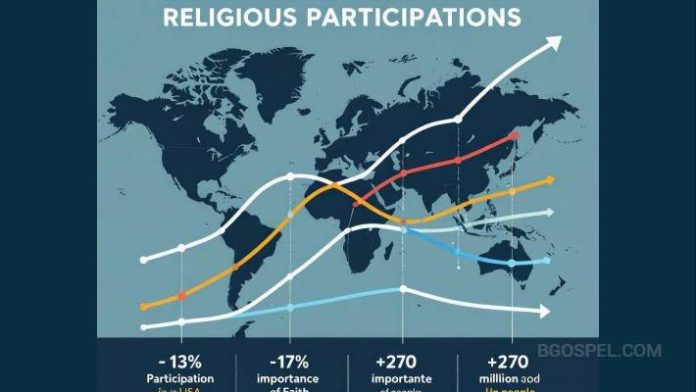

In the majority Muslim countries, the fall slows down at the first two stadiums: participation drops, but affiliation remains strong.
According to the study, the trend affects all major religions (Christianity, Islam, Hinduism, Buddhism), although the data is particularly robust for international Christian societies.
The young generations are increasingly “spiritual but non -religious”, preferring individual forms of belief.
For evangelical communities, this dynamic implies a radical transformation of the modes of transmission of faith, the need to innovate on the relational and missional level to maintain an effective presence within quickly secularized societies.
Methodology and scope
The study is based on data from Pew Research Center, World Values Survey and European Values Study, covering more than 100 countries and several decades of religious evolution.
Key facts
-
The GDP sequence is the dominant trajectory of religious decline.
-
Between 2010 and 2020, religious disaffiliation reached 13 % in the United States, 16 % in Australia and 17 % in New Zealand and Canada.
-
Europe displays secularization records, while Africa remains the most religious region to date.
-
Secularization is also observed in Muslim societies, although differences remain depending on the region.
Impact and evangelical implications
This decline questions the future of collective Christian testimony, encourages new forms of community and invites us to rethink evangelization and faith training strategies with new generations. This is a major issue for the entire world religious landscape, in particular for evangelical circles concerned with the vitality of the mission.
Sources
